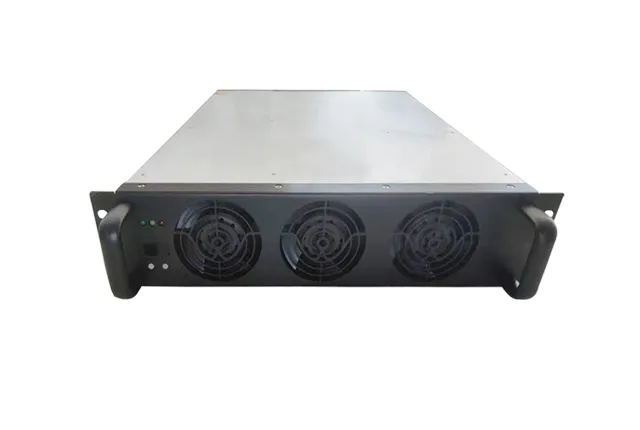
Choosing the right DC charging module starts with five key factors: output voltage range, module power, conversion efficiency, thermal design, and system compatibility. For most commercial DC fast chargers, the module should offer a sufficiently wide constant-power voltage range, stable parallel operation, CAN-based communication, and reliable performance under continuous high-load conditions.
For charging equipment manufacturers, the best DC EV charger module is not necessarily the one with the highest kW rating. Instead, it should be selected based on the vehicle's voltage range, charger architecture, grid conditions, cooling system, and expected operating environment.
A DC charging module is the core power-conversion unit inside a DC fast charger. It converts incoming electrical power into the controlled DC voltage and current required by the EV battery.
Unlike AC charging, where the vehicle's onboard charger performs the main AC-to-DC conversion, off-board DC fast charging performs the power conversion inside the charging station. This enables the charger to deliver higher power directly to the vehicle battery and significantly reduces the charging time.
Modern DC fast chargers typically use a modular architecture that combines multiple power modules to achieve the required system output. For example, several 30 kW, 40 kW, or 50 kW modules can operate in parallel to create different charger power configurations while maintaining a common platform. This architecture also makes maintenance, power distribution, and future capacity expansion easier.
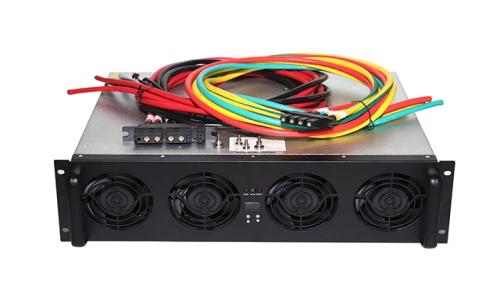
An AC-DC EV charging module takes AC power from the grid and converts it into regulated DC power. This is the most common power-module architecture for conventional public DC charging stations.
A DC-DC EV charging module receives an existing DC input and converts or regulates it to the voltage required by the vehicle. It is particularly relevant to charging systems connected to battery energy storage, photovoltaic systems, DC microgrids, or other DC power sources.
The choice therefore depends mainly on the charger's upstream power architecture:
Grid-connected DC charger: AC-DC modules are normally the primary choice.
Energy-storage or DC-bus charger: DC-DC modules can provide more direct power conversion.
Hybrid charging system: Both AC-DC and DC-DC conversion stages may be used, depending on the overall system topology.
Voltage compatibility should be evaluated before module power.
A sufficiently wide output voltage range allows a charger to support a broader range of EV battery platforms. Commercial DC charging modules are commonly available with output voltages up to 1000 VDC, while newer high-voltage products can reach 1500 VDC for next-generation high-power charging applications.
For 400 V and 800 V vehicle platforms, do not focus only on the maximum output voltage. Pay attention to the constant-power operating range, because a module may not provide its full rated power across its entire voltage range.
Choose module power according to the total charger rating and desired power granularity.
For example, a 240 kW charger built with 40 kW modules can use six modules at full capacity. A modular architecture also makes power distribution, maintenance, and future product expansion easier.
Check the manufacturer's permitted parallel quantity, current-sharing accuracy, and module hot-swap strategy before finalizing the charger design.
Efficiency directly affects electricity losses, cabinet temperature, cooling requirements, and operating cost.
For commercial fast-charging projects, evaluate both peak efficiency and efficiency across the actual load range. Current high-performance charging systems and modules commonly operate in the mid-to-high 90% efficiency range under rated conditions.
Air-cooled modules are widely used because of their simpler system design and maintenance. Liquid-cooled modules become more attractive when higher power density, lower acoustic noise, or demanding thermal conditions are required.
For outdoor chargers, also verify derating behavior at high ambient temperatures. A module that reaches its rated power only under laboratory conditions may reduce the actual output of the charging station during hot-weather operation.
A qualified EV charging module should integrate reliably with the charger's control system and provide stable communication, monitoring, and protection functions. CAN communication is widely supported in commercial charging modules and power electronics.
Important factors include:
CAN communication and monitoring
Voltage and current regulation accuracy
Overvoltage and overcurrent protection
Overtemperature and short-circuit protection
Power-factor and harmonic performance
EMC compliance
Current sharing between parallel modules
Fault reporting and remote diagnostics
These specifications can have a greater impact on long-term charger reliability than nominal module power alone.
30–60 kW DC chargers: prioritize compact size, cost efficiency, wide vehicle compatibility, and simple, reliable air cooling.
120–240 kW public fast chargers: focus on efficiency, scalable parallel operation, wide constant-power range, thermal performance, and easy module replacement.
300 kW+ high-power charging systems: power density, high-voltage capability, advanced cooling, current-sharing accuracy, and long-duration reliability become more important.
Fleet and heavy-duty charging: consider high utilization rates rather than only peak charging power. Modules may operate for many hours per day, making efficiency, temperature derating, and lifecycle reliability critical purchasing criteria.
It depends on the vehicles being served. For mixed public charging, a wide output range up to 1000 VDC provides compatibility with many current 400 V and 800 V vehicle architectures. Applications targeting future heavy-duty or very high-voltage systems may evaluate 1500 V-class solutions.
No. Higher module power can improve power density and reduce module count, but thermal design, redundancy, maintenance strategy, cost, and power-allocation flexibility must also be considered.
Yes. Parallel operation is a fundamental feature of modular DC fast chargers. However, verify the manufacturer's maximum parallel quantity, current-sharing performance, communication architecture, and fault-isolation strategy. Some commercial module platforms support dozens of modules operating in parallel.
Start with voltage compatibility and constant-power performance, then evaluate efficiency, module power, cooling, communication, protection, certification requirements, and expected duty cycle.
For charger manufacturers and system integrators, selecting the right DC charging module is ultimately a system-level engineering decision. A well-matched module improves charging compatibility, reduces thermal stress, simplifies power expansion, and helps the complete charger maintain reliable output throughout its service life.
Save cost-with manufacturer direct pricing
Control quality-with strict quality control and testing
Save time-with experienced team to get project done
 English